Darkfactory planned company
A subsidiary of ALXEVT · brand of ABS COMPANY INC.
What it is
Darkfactory is a planned subsidiary of ALXEVT, the corporate brand of ABS COMPANY INC., which would remain the operator of record. It is a company on paper. There are no clients, no revenue, no delivered projects, no pilots and no case studies, and there is no site on its own domain — this page is the whole of it. What exists is the delivery model: a rough business idea goes in, and a production‑ready web tool and website come out within twenty‑four hours, with the client appearing exactly once, to approve a BRD carrying the market research. The name is the manufacturing term — a dark factory is lights‑out production, no human on the floor — set as one word by owner decision on 27 August 2026. It is not a claim about secrecy, and not a claim about a factory that is running. Everything below describes the model. None of it describes a record, because there is not one yet.
This company is planned. It has no clients, no revenue and no delivery history, and nothing on this page describes work already done. The mark below is a proposal awaiting the owner’s adoption. Where something does not exist yet, this page says so.
The mark, read
- The egg
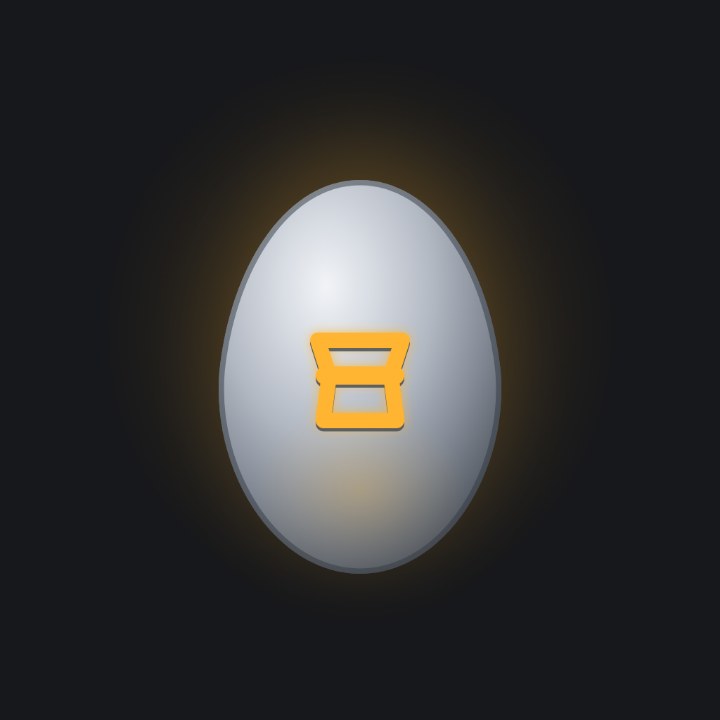
- Life — that which is about to exist, and the form every ALXEVT subsidiary wears. The owner’s rule is that all of the daughters are palladium eggs, so the family is read before the company is. It is never bare and never circled by orbitals — that is the parent’s Palladium Egg — and never visored, which belongs to the Saint Egg.
- The palladium
- The catalyst metal: noise in, signal out, the catalyst itself unconsumed. On the maturity ladder palladium is the target rung, and the subsidiary wears it as the goal rather than as a report — the owner’s reason is that the goal must be challenging. Inside ALXEVT’s own registry this company is still graded honestly at foundation, because nothing has been built. The public metal states the ambition; the internal ladder states the state. The two are never swapped.
- The inlay — the split‑flap tile
- One Solari flap caught mid‑flip, inlaid in the shell: a lower leaf standing, an upper leaf tipped forward and foreshortened by its own rotation, and a seam of amber light between them. An inlaid instrument is the classifier’s grammar for this is what the thing does — here, the twenty‑four‑hour window held at one instant: the character has already changed, the board has not finished saying so. The seam is the only light in the mark, and it is where the client stands — one approval, one lit line. It is drawn to the family construction — single weight, round caps and joins, no text, no likeness — and reduced to two leaves and a seam rather than a whole board, because a board is the weakest thing in the pool at favicon size. Status: proposed, not adopted. No subsidiary inlay has been adopted by the owner; until one is, this is a candidate and is labelled as one wherever it appears.
- The dark tile
- The Solari departure board is the stage on which the parent announces itself, and this company would inherit it one stop darker: the board as the factory’s single lit window on an unlit building. The rows would read as the standing timetable — intake, research, BRD, SRS, build, ship — with amber spent exactly once, on the BRD row, the one line where a client exists. That treatment is described, not built: it is a design for a site that does not exist, and it would have to stay visibly distinct from alxevt.com’s own board, or parent and subsidiary read as one company.
The delivery model
The model below is designed, not demonstrated. It states how the company would work if it were operating. Nothing in it has been run for a client, and no figure in it has been measured.
- Input
- An open, rough business idea — a sentence, not a brief. Nothing needs to be specified at entry: no requirements, no feature list, no wireframes. An input that is already fully specified is work for a sibling company, not for this one.
- The gates
- Four, in order. An understanding check — minimal questions, only enough to confirm the idea was read correctly. Then market and competitor research, done autonomously. Then a BRD carrying that research, sent for approval. Then an SRS specifying the features to the best standard the domain has, frozen before the build begins.
- Client involvement
- Two touches, one of which is a decision. The client answers the understanding questions, then approves or rejects the BRD. Before, between and after those points the client spends no time. The BRD is the only place the product can still be steered.
- Output
- A production‑ready product in two pieces: the web tool and the website that fronts it — built to ship, not to demonstrate.
- The window
- 24 hours, from confirmed intake to a product that is live. That is a specification the company would be held to, not an average of anything: no build has been run, so nothing has been timed.
- The trade
- Speed and autonomy, bought with a very narrow steering window. A client who wants to shape the product while it is being built is asking for continuous co‑definition, which is PSAIO’s model, not this one. Painting a deadline into an identity carries its own cost, and it is stated rather than hidden: a missed window would be a public failure by construction.
- What “dark” means
- Lights‑out production — a floor that needs no lighting because no human is standing on it. The claim is about the floor and nothing else. The client exists, at intake and at the BRD; the term has to be explained before it can reassure, which is why it is explained here first.
- Where it sits
- The four business models of ALXEVT’s planned subsidiaries lie on one axis, from the client defines everything with us to no client exists yet: PSAIO, Board of Experts, Darkfactory, Agentic Business Studio. Darkfactory is second from the autonomous end — it takes the least defined input of the three commissioned models, and returns the least client time.
Package status
Seven parts make a company package: brand, website, tools, strategy, roadmap, economics, products. Honest state of each — proposed means drawn or drafted and awaiting the owner; open means the question is live; not started means exactly that.
The owner’s deliverable for each subsidiary is a seven‑part package. This is where Darkfactory’s stands on 26 August 2026: two parts exist as drafts, one is this page, and four are empty. Where a part is empty it is listed as empty rather than left out.
- Brand
- Proposed, not adopted. The mark is a palladium egg with the split‑flap tile inlaid, described above; the board‑room treatment and the voice lines are drafted. Adoption is an explicit owner decision and has not been made. The name is on the owner’s closed roster of five, and was set to one word by owner decision on 27 August 2026. ados darkfactory, a SAINT product name, is shared with this company deliberately — the tool is named for the company whose model it runs, and that is not a collision.
- Website
- This page, and nothing else. There is no site on a domain of its own; domain work is parked by owner decision until a package actually ships a site, so no address is claimed or reserved here. The only address published anywhere in this record is developer@alxevt.com.
- Tools
- None built. This is the largest unbuilt piece and the one the model depends on: a 24‑hour window presupposes a working pipeline — research, BRD and SRS generation, build, test and deploy — running without a human on the floor. None of that machinery exists yet. Until it does, the window is a specification and not a capability.
- Strategy
- Partial. The delivery model is defined and the company’s position among its siblings is defined. Market segment beyond “small and medium business”, competitive positioning and go‑to‑market are not decided.
- Roadmap
- Empty. No milestones, no sequence, no dates — including no date for the first build. Nothing has been scheduled, so nothing is promised.
- Economics
- Not modelled. No price, no cost model, no unit economics, no capacity figure for how many intakes a 24‑hour window could carry at once. The window has cost consequences that have not been calculated.
- Products
- None. Zero delivered products, zero clients, zero pilots, and no internal dry run on record. The portfolio is empty, and it is shown empty.
What it inherits
Every ALXEVT company is a palladium egg — the family form — with one instrument inlaid to say what it specialises in. The bare shell and the three orbitals belong to the parent alone (the ALXEVT Palladium Egg), and the visor belongs to the Saint Egg. The companies also inherit the parent’s ascent picture, its 16 Pillars as cross‑cutting method, and its technological stack.
The metal is deliberate: palladium is the target of the maturity ladder, not the rung any of these companies has reached. They are drawn at the level they aim for, because the goal is meant to be a hard one.