Board of Experts planned company
A subsidiary of ALXEVT · brand of ABS COMPANY INC.
What it is
Board of Experts is a planned company — a subsidiary of ALXEVT, to be operated by ABS COMPANY INC. It has no clients, no revenue, no delivered engagements and no history, and nothing on this page describes work that has been done. What exists today is the model: solving complex problems for clients as a premium escalation, taken on after the client’s own staff has already worked against the same requirements and could not deliver. The name is settled. The mark below is a proposal awaiting the owner’s adoption. The site, the domain, the pricing and the roster do not exist yet. This page states what the company is designed to be, and says plainly where it is still only a plan.
This company is planned. It has no clients, no revenue and no delivery history, and nothing on this page describes work already done. The mark below is a proposal awaiting the owner’s adoption. Where something does not exist yet, this page says so.
The mark, read
- The egg
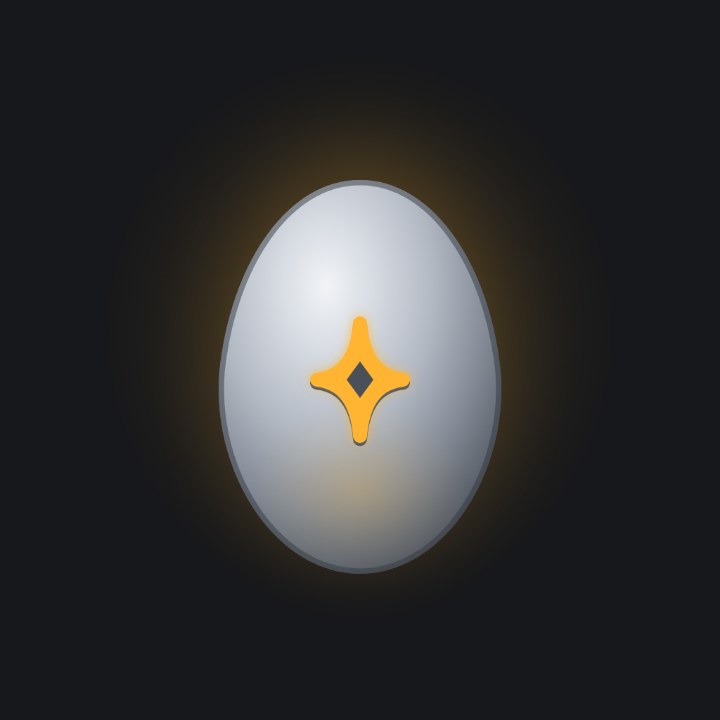
- Life — that which is about to exist. Every ALXEVT subsidiary wears the same shell, because the owner settled it that way: the daughters are palladium eggs, and they differ only in what is inlaid. This one is never bare and never carries orbitals — a bare shell and three rings of light are the parent’s Palladium Egg — and it never wears the Saint Egg’s visor.
- The palladium
- The catalyst metal, and the summit of the maturity ladder. Here it states the target, not the achievement: on ALXEVT’s own classifier a company this new grades at foundation, and the shell is palladium because the goal is meant to be the hard one. Read the metal as the level this company is climbing toward, never as a level it has reached.
- The inlay — the four‑ray star
- The specialization, inlaid in the shell rather than punched beside it: four rays pinned to one point, a coordinate fix on the single problem confirmed at the gate. The vertical axis is the major one, the horizontal the minor, so it reads as an axis and not as an ornament. At its centre is a set stone in a cut mount — a diamond, never a circle, which is also what keeps this mark clear of the coin and the struck medal proposed for two sibling companies. Below roughly 24 px the mount closes and the star reads solid; that reduction is declared, not a defect. The star has never been adopted in any form: adopting it here would be its first.
- The dark tile
- The Solari departure board the mark is staged on — the parent’s stage, where a company announces itself. It is the one element of this identity that already exists, and it exists because it belongs to ALXEVT.
Where this star comes from
The four‑ray star was drawn earlier as a proposed third company mark, the ALXEVT Star, and was never adopted as one. On 27 August 2026 the owner gave it to Board of Experts as its specialization inlay, which closes that candidate: a subsidiary’s inlay and a company mark cannot share a silhouette without the tier boundary collapsing. The geometry, its construction rules and its reasoning carried over intact.
One constraint travelled with it on its own technical merit: the concave flanks are load‑bearing. Straightening them toward a compass rose measurably worsens the collision with the business coin, so the concavity is not a style preference and is not available to trade away.
The delivery model
Everything below is the designed model, stated as a design. None of it has been run: there has been no gate, no engagement, and no delivery.
- Input
- One task that is hard, unresolved, or too important to get wrong — and that the client’s own staff already attempted, against these same requirements, and could not deliver. The prior failure is the intake filter. The task is hard by demonstration, not by assertion.
- Requirements
- Well defined at entry, because the client wrote them already: they are what the internal team was working against. They are confirmed at the gate and then frozen. What is unresolved is the execution, never the specification.
- The gate
- One session, at entry. It confirms three things: the requirements, the standard the domain holds as its highest, and the post‑mortem — what was attempted and how it failed. It also settles whether the specification itself was the fault, because accepting a broken specification as “well defined” would inherit the very defect that caused the failure.
- Client involvement
- The gate, and after it none — no review meetings, no steering, no client hours. The client has already spent that time and lost it; the model is built so they do not spend it twice.
- Output
- The task delivered complete, to the highest standard achievable in that domain. Where the gate finds the specification was the defect, that finding is the delivery — stated plainly, and a legitimate outcome rather than a failed engagement.
- Positioning
- Premium escalation, not outsourcing. It is designed to compete on depth of expertise and quality of execution — never on price, speed or convenience.
- The trade
- The highest price of the five ALXEVT companies, and the narrowest intake: by design it can only take work worth that standard. Work no competent team has yet attempted does not belong here.
- Not yet defined
- How a domain’s highest standard is evidenced at the gate, who sits on the board, and what any of this costs. None of that is decided, and nothing above should be read as implying it.
Package status
Seven parts make a company package: brand, website, tools, strategy, roadmap, economics, products. Honest state of each — proposed means drawn or drafted and awaiting the owner; open means the question is live; not started means exactly that.
ALXEVT’s deliverable for each subsidiary is a seven‑part package: brand, website, tools, strategy, roadmap, economics, products. This is where Board of Experts actually stands today.
- Brand
- Partly drafted. The name is settled by the owner. The mark is a proposal: the family form — a palladium egg — is fixed, and the four‑ray star inlay is not adopted. Type and palette are inherited from the parent’s family constants; nothing subsidiary‑specific has been chosen.
- Website
- None. This page, on the parent’s site, is the only published description of the company. No domain is registered: the exact name is already taken at the common top‑level domains, and domain work is deliberately parked until a package is ready to ship a site.
- Tools
- None built. The company owns no software — no intake system, no delivery tooling, nothing running.
- Strategy
- One line of it exists: premium escalation, with intake qualified by prior internal failure. Market definition, channel, and how a domain’s highest standard is evidenced are all unwritten.
- Roadmap
- None. No dates, no milestones, no launch. Nothing on this page is a schedule or a commitment to one.
- Economics
- Unwritten. No price, no cost model, no unit economics — and no revenue, because there are no clients to have revenue from.
- Products
- The engagement is the product, and none has been run. Zero engagements, zero case studies, no references — and there will be none to show until there is a first client.
Operator of record: ABS COMPANY INC. The only address for this company is developer@alxevt.com, which reaches the parent — the company itself is not operating.
What it inherits
Every ALXEVT company is a palladium egg — the family form — with one instrument inlaid to say what it specialises in. The bare shell and the three orbitals belong to the parent alone (the ALXEVT Palladium Egg), and the visor belongs to the Saint Egg. The companies also inherit the parent’s ascent picture, its 16 Pillars as cross‑cutting method, and its technological stack.
The metal is deliberate: palladium is the target of the maturity ladder, not the rung any of these companies has reached. They are drawn at the level they aim for, because the goal is meant to be a hard one.